
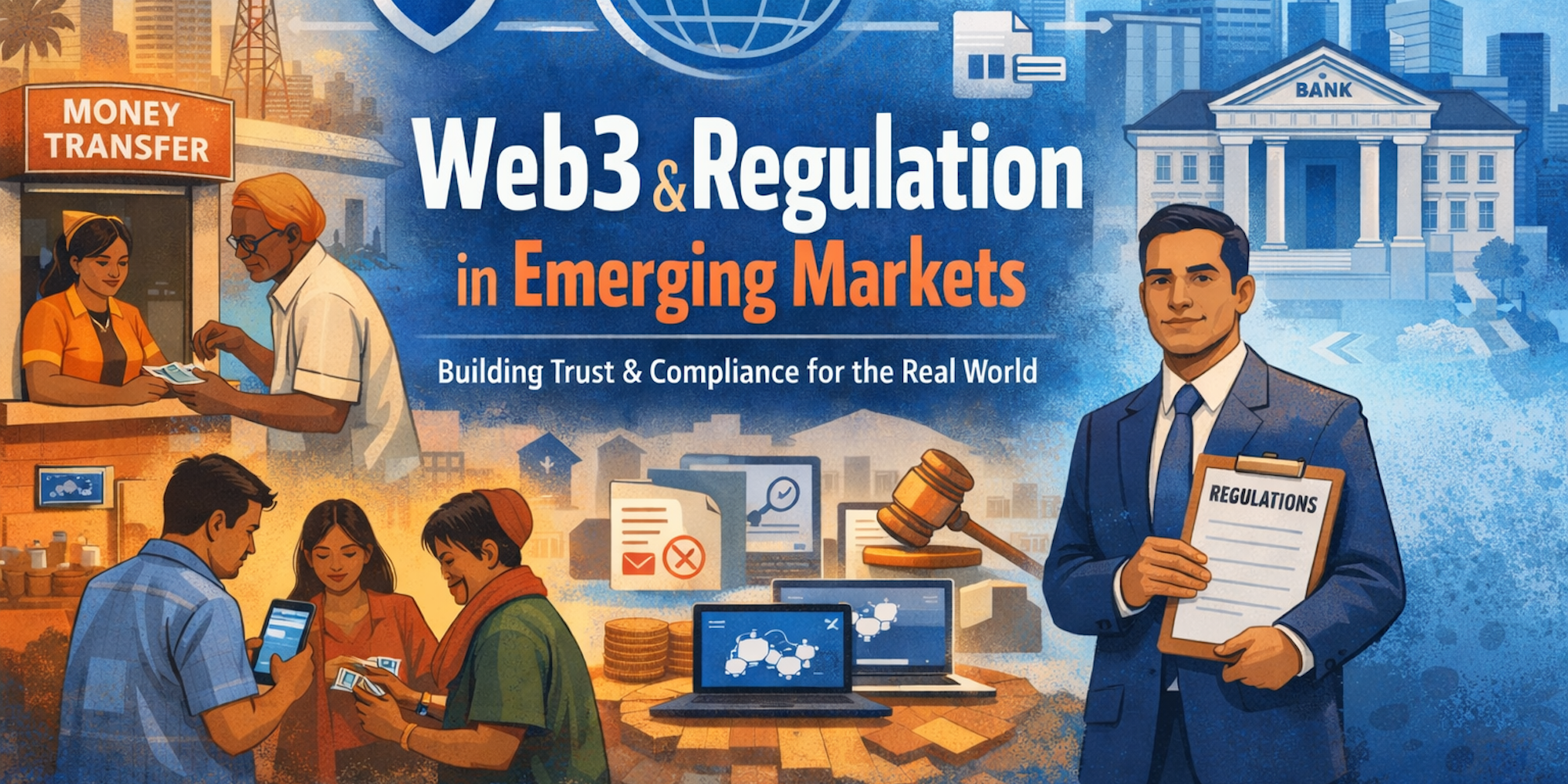
For much of its short history, Web3 has thrived on a powerful narrative: disintermediation, permissionlessness, and freedom from legacy systems. That story has been compelling, especially in emerging markets, where traditional financial infrastructure is often expensive, exclusionary, or simply absent.
But as Web3 moves from experimentation to real-world deployment, serving millions of users, handling remittances, savings, and everyday payments, the limits of an anti-regulation mindset are becoming painfully clear.
In emerging markets, regulation is not a brake on innovation. It is the condition for scale, trust, and durability. And the more Web3 touches real people’s money, identity, and livelihoods, the more regulation will matter, not less.
Emerging Markets Are High-Impact, High-Responsibility Environments
Emerging markets are often portrayed as “regulatory arbitrage zones”: places where innovation can move faster because rules are unclear, under-enforced, or still evolving. This framing is not just inaccurate, it is dangerous.
In reality, emerging markets combine three characteristics that increase, rather than reduce, the need for strong regulatory alignment:
- Users are more vulnerable
Many users are first-time participants in formal finance. A single failure, lost funds, fraud, or abuse, can erase years of savings. - Trust in institutions is fragile
Financial scandals or collapsed schemes spread quickly and permanently damage confidence, not just in one product but in entire sectors. - Systemic impact happens fast
When Web3 rails are used for remittances, welfare payments, or salary flows, small design mistakes can have large macro-economic consequences.
In this context, deploying unregulated or loosely governed Web3 services is not “empowering”, it is reckless.
Regulation Is How Trust Scales Beyond Early Adopters
Early crypto adoption was driven by a narrow group: technically literate users willing to self-custody, self-verify, and self-insure. That group is now saturated.
The next billion users will look very different:
- Feature-phone users
- Migrant workers
- Rural households
- Elderly or low-literacy populations
- Small merchants and informal workers
These users do not want ideology. They want:
- Clear recourse
- Predictable rules
- Protection against abuse
- Services that work every day
Regulation is the mechanism that converts personal trust (“I trust this app”) into systemic trust (“I trust the system behind this app”). Without it, Web3 cannot move beyond niche usage.
Financial Crime Risk Is Not a Side Issue. It Is Central
Emerging markets are under intense international scrutiny for:
- Money laundering
- Terrorist financing
- Sanctions evasion
- Capital flight
Any new financial rail, especially one using crypto assets, is immediately evaluated through this lens.
When Web3 builders treat compliance as an afterthought, three things happen:
- Banks refuse to connect
- Regulators block or delay deployments
- Governments conflate legitimate innovation with illicit finance
This is why KYC, AML, Travel Rule compliance, transaction monitoring, and auditability are not optional extras. They are the price of admission into regulated financial ecosystems.
The uncomfortable truth is this:
If you cannot explain where funds come from, where they go, and who controls them, you will not scale, no matter how good your technology is.
Regulation Is How Web3 Integrates with the Real Economy
Remittances do not exist in isolation. They touch:
- Telecom operators
- Cash-in and cash-out agents
- Banks and payment institutions
- FX controls
- Tax authorities
- Consumer protection frameworks
Ignoring regulation does not make these actors disappear, it simply isolates your product.
The Web3 services that will succeed in emerging markets are those that:
- Respect existing financial roles
- Integrate cleanly with licensed institutions
- Clarify liability rather than obscuring it
- Make compliance auditable by design
In other words, Web3 must stop trying to “replace” regulation and start embedding itself within regulated ecosystems.
Regulators Are Not the Enemy. They Are the Signal
A common mistake among Web3 founders is assuming regulators are hostile to innovation. In emerging markets, the opposite is often true.
Many regulators are actively seeking:
- Better visibility into informal flows
- Lower remittance costs
- Financial inclusion beyond smartphones
- Safer alternatives to cash
- Tools that reduce corruption and leakage
But regulators cannot support what they cannot understand.
Projects that proactively:
- Engage early
- Explain their architecture clearly
- Accept regulatory constraints
- Design compliance into the product
…are consistently treated differently from projects that try to “launch first and ask forgiveness later.”
Regulation is not a wall. It is a signal, telling you whether your system is legible, accountable, and mature enough for public use.
The Future of Web3 in Emerging Markets Is Regulated by Default
As Web3 matures, three shifts are inevitable:
- From wallet-centric to service-centric regulation
Regulators care less about the technology and more about the function: remittance, custody, savings, lending. - From optional compliance to embedded compliance
Compliance will be part of the infrastructure layer, not bolted on at the edges. - From experimental pilots to national-scale deployments
Governments will not tolerate “black boxes” once millions of citizens are involved.
The winners will not be the loudest or the most ideological. They will be the builders who accept a simple reality:
In emerging markets, regulation is not the cost of doing business.
It is the foundation that makes real impact possible.
Conclusion: Regulation Is Not the End of Web3’s Promise. It Is Its Fulfillment
Web3 has the potential to radically improve access to financial services in emerging markets. But that promise only materializes when innovation meets responsibility.
Regulation is how:
- Trust becomes durable
- Inclusion becomes safe
- Scale becomes possible
- Innovation becomes legitimate
The question is no longer whether Web3 should be regulated in emerging markets.
The real question is:
Who will build Web3 systems that are compliant by design and therefore ready for the real world?
Those are the systems that will still be standing ten years from now.