Yesterday, the stablecoin industry had its biggest governance moment since the token category exploded into the mainstream. More than 140 companies — spanning payments, banking, and crypto — announced they were backing a new stablecoin called Open USD (OUSD), built and operated not by a single issuer, but by a consortium.
We think this announcement is significant — not because of the token itself, but because of what it confirms about where global money movement is headed. Below, we break down what was actually announced, why it matters, and why it validates something we’ve believed for over a year, well before it was consensus.
What was announced
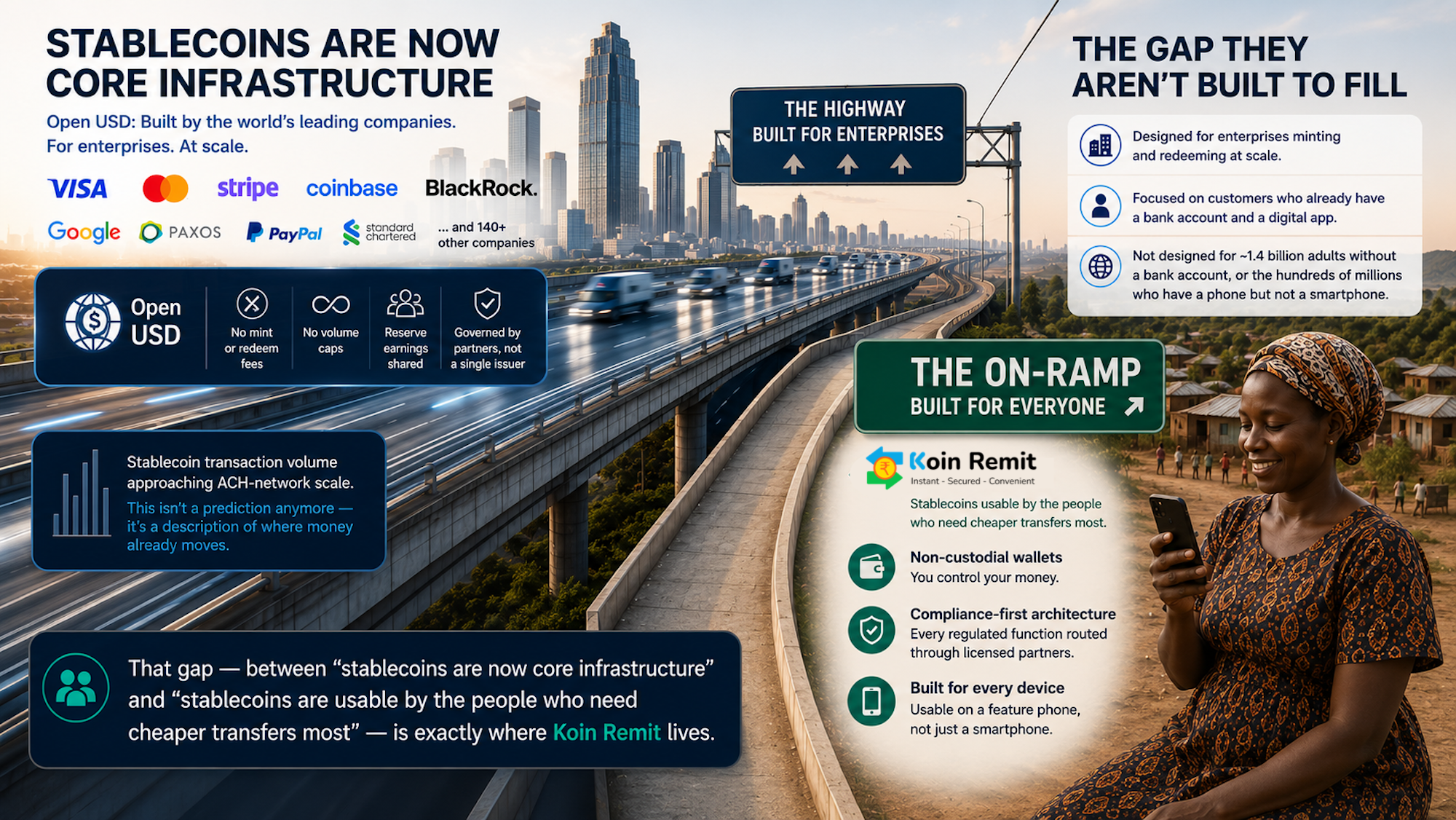
Open USD is a new stablecoin for global money movement, introduced by an entity called Open Standard. The partner list reads like a cross-section of the entire payments and finance industry: Visa, Mastercard, American Express, and Stripe on the payments side, BlackRock, BNY, Standard Chartered, U.S. Bank, and BBVA from traditional finance, and Coinbase, Ripple, Galaxy, OKX, and Bybit from crypto. Google, Shopify, IBM, and DoorDash joined from the technology and platform side.
Three design choices distinguish Open USD from every major stablecoin that came before it:
- No mint/redeem fees, no volume caps. Businesses can mint and redeem the token for free, with no artificial ceiling on volume — a direct answer to complaints that existing stablecoins become expensive at enterprise scale.
- Shared reserve economics. Partners keep the earnings generated by the reserves backing the coin, minus a small fee to cover operating costs — rather than that yield accruing entirely to a single issuer, which is how Tether and Circle currently monetize USDT and USDC.
- Collective governance. A board made up of Open USD’s partners governs the project, rather than a single company controlling it.
Open USD is expected to launch later this year. Notably, on the chain question, reporting is inconsistent: some outlets tie the launch specifically to Solana, others to Stripe’s Tempo network, and at least one report lists additional chains including Polygon. We’d treat the specific technical rollout as unconfirmed until Open Standard publishes it directly — the governance and economics of the announcement are what’s solid, not yet the infrastructure details.
Who’s in, and who’s conspicuously not
Tether and Circle — the two companies that have built and dominated the stablecoin market to date — are not part of the consortium. That’s not an oversight. It’s the entire point. Open USD exists because the stablecoin market, until this week, worked on a simple model: whoever controlled issuance of the largest token controlled the economics, with reserve income flowing to the issuer while everyone else operated as infrastructure supporting someone else’s balance sheet. Open USD’s backers — many of whom have spent years distributing USDC and USDT to their own customers — are, in effect, building an alternative to being permanently subordinate to someone else’s stablecoin economics.
Circle’s stock fell roughly 13% following the announcement. That reaction alone tells you how seriously the market is taking this as a structural threat to the current order, not just another entrant in a crowded field.
What this signals for stablecoins broadly
Three things stand out, beyond the headline:
1. Stablecoins have crossed from experiment to infrastructure. When Visa, Mastercard, BlackRock, and Stripe co-sign a stablecoin launch, the “is this a real financial instrument or a crypto toy” debate is over. The launch is happening as stablecoin transaction volume approaches that of the ACH network — one of the core rails of the entire US financial system. This isn’t a prediction anymore. It’s a description of where volume already is.
2. The competitive battle has moved from tokens to networks. Rather than competing to own the largest digital asset by market cap, the real contest is now about who builds the largest, most interoperable financial network on top of shared programmable-money infrastructure. This is the same shift every commoditized-rail industry goes through — the winners stop being the ones who own the pipe and become the ones who own the relationships and experience built on top of it.
3. This isn’t the first consortium, but it’s the biggest. Paxos launched a similarly structured coalition-backed stablecoin, USDG, through the Global Dollar Network in late 2024, with participants including Mastercard, Robinhood, and Kraken. Open USD is that same idea, executed at a scale and with a partner list an order of magnitude larger. The pattern is now established, not novel: shared governance and shared economics are becoming the default model for how new entrants challenge single-issuer incumbents.
The part of the story that isn’t being told
Here’s what’s conspicuously absent from every headline, every executive quote, every analyst take on Open USD: any mention of the roughly 1.4 billion adults worldwide who don’t have a bank account, or the hundreds of millions more who have a mobile phone but not a smartphone.
Look at who Open USD is built for. The stated use case is businesses that move large volumes of dollars and need a cheaper way to mint and redeem stablecoins at scale. Even the remittance-adjacent voice in the announcement frames the value proposition around abstraction, not inclusion — Félix’s CEO noted that customers care about getting local currency quickly and at a fair price, not about which rail moves the money behind the scenes. That’s a true and reasonable statement. It’s also a statement made from the perspective of a company serving customers who already have a bank account, a smartphone, and access to a digital financial app in the first place.
That’s not a criticism of Open USD. Building infrastructure for enterprise-scale money movement is genuinely valuable, and cheaper, faster settlement for large volumes eventually filters down to end users in the form of lower fees. But “eventually filters down” is not the same as “designed for.” The entire consortium — 140+ companies — is optimizing for businesses that already sit inside the financial system. Nobody in that list is optimizing for the person receiving support from family abroad on a feature phone, who has never had a bank account, and who lives in a market where the smartphone penetration numbers that every fintech roadmap assumes simply aren’t true yet.
Why this validates our thesis
We didn’t build Koin Remit because stablecoins were a proven, mainstream way to move money. We built it before that was true, on the belief that they would become exactly that — faster, cheaper, more transparent than the correspondent-banking rails that currently move remittances, and increasingly the default infrastructure choice of the biggest players in global finance.
Yesterday’s announcement is that belief, confirmed, from the most credible possible source: not a crypto conference, but Visa, Mastercard, Stripe, and BlackRock putting their names on a stablecoin at the same time.
But the announcement also confirms the second half of our thesis, maybe more importantly than the first: the biggest players building this infrastructure are not building it for the people we built Koin Remit for. They’re building the highway. We’ve spent our time building the on-ramp for people who’ve never had a car — the non-custodial wallet experience, the compliance-first architecture routing every regulated function through licensed partners, and critically, the device-level work to make all of this usable on a feature phone rather than assuming a smartphone that the intended user doesn’t have.
That gap — between “stablecoins are now core financial infrastructure” and “stablecoins are usable by the people who most need cheaper cross-border transfers” — is exactly where Koin Remit lives. Big finance validated the first half yesterday. We’ve been building the second half for the past year.
What happens next
To be clear: Kivi3 has no affiliation with Open Standard, Open USD, or any of the companies involved in yesterday’s announcement. Koin Remit’s infrastructure runs on its own stablecoin rails (USDC and EURC on Polygon), and nothing here should be read as a partnership claim, an integration announcement, or an endorsement in either direction.
What we do think is worth saying plainly: when the industry’s biggest players spend a news cycle confirming that stablecoins are the future of global money movement, it’s worth asking who that future is actually reaching first. For the past year, our answer has been: not enough people, and not the people who need it most.
Next week, we take another step toward closing that gap — bringing Koin Remit to feature phones in India for the first time. More very soon.